
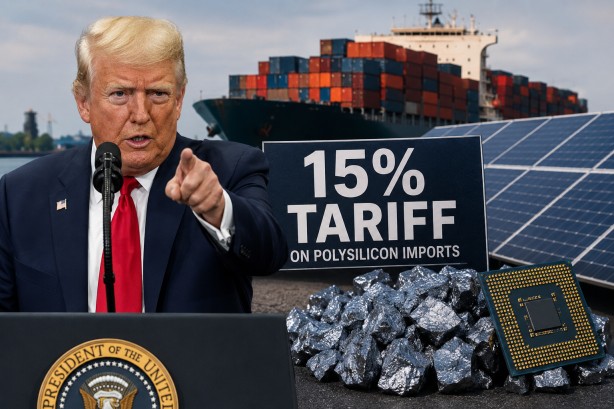
In a strategic move to bolster domestic production and reduce dependency on China, President Donald Trump has announced a 15% tariff on imports of products containing polysilicon, a critical component in semiconductor and solar panel manufacturing. Set to take effect on December 4, this tariff is part of a broader effort to enhance the United States’ economic and national security by reinforcing key supply chains.
Polysilicon, an ultra-pure silicon form, is essential for producing semiconductors used in artificial intelligence systems and data centers, as well as solar cells and panels. Currently, China dominates the global production of this material. To further support domestic producers, the new policy establishes minimum import prices: $21 per kilogram for polysilicon, $100 per kilogram for polysilicon ingots and wafers, $0.22 per watt for solar cells, and $0.38 per watt for solar modules and panels.
The tariff aims to ensure the commercial viability of U.S. polysilicon production facilities, notably those operated by Hemlock Semiconductor in Michigan and Wacker Chemie in Tennessee. Additionally, the policy allows for the introduction of incentives for companies investing in domestic polysilicon and related manufacturing infrastructure.
China has voiced strong opposition to this measure, accusing the U.S. of exploiting national security concerns to unfairly limit Chinese business operations. Beijing warns that such protectionist policies could lead to trade disruptions between the two economic powerhouses. Meanwhile, China continues to see robust growth in its export sectors, particularly in electronics, artificial intelligence-related products, and other high-value manufacturing areas.
