
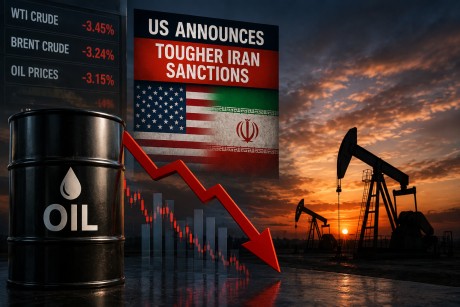
Oil prices experienced a significant decline of over 3% on Tuesday, hitting their lowest level in a week as investors evaluated the implications of new US sanctions against Iran. These sanctions are aimed at escalating pressure on Tehran amid ongoing tensions. Brent crude, serving as the global benchmark, fell by 3.1% to $89.31 per barrel, while West Texas Intermediate (WTI) saw a 3.34% drop to $82.17. This downturn followed a period of strong gains the previous week, where Brent had surged by 6.6% and WTI had increased by 5.7%.
The expanded US sanctions target businesses and nations engaged in economic activities with Iran, aiming to disrupt its economy. Despite the geopolitical risks associated with these measures, market focus shifted towards the potential effects on Iranian oil exports. Traders are closely monitoring the situation to determine whether these sanctions could significantly impact the flow of Iranian oil into the global market.
Concerns over the Strait of Hormuz, a critical global energy route, continue to loom large. Iranian authorities have issued warnings that oil shipments through this strategic waterway could be halted if the US continues to exert further pressure. This potential threat adds a layer of uncertainty to the already volatile energy markets.
Additionally, the risk to shipping routes has increased, highlighted by a recent incident where a tanker was reportedly struck near Oman’s Musandam peninsula. Ongoing attacks in the Red Sea have further compounded the instability, casting doubt over the security of global energy supplies.
Despite these developments, the immediate market reaction was a decrease in oil prices, as traders prioritized the potential repercussions of the sanctions. The focus remains on whether these new measures will lead to a significant reduction in Iranian oil exports, which could have broader implications for global energy supply and demand dynamics.
