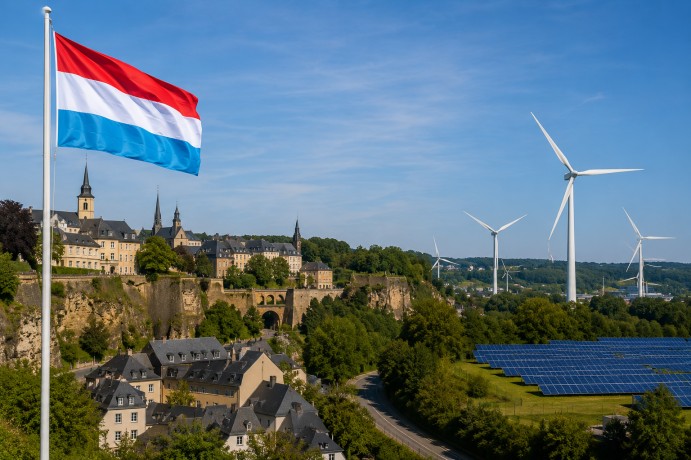
Luxembourg has found itself among the three lowest-ranking European Union countries for renewable electricity consumption in 2025, as revealed by the latest figures from Eurostat. Despite a general upward trend in renewable energy usage throughout the EU, Luxembourg’s performance remains lackluster. The data shows that renewable sources contributed to just 20.2% of Luxembourg’s gross final energy consumption, placing it near the bottom of the list. Specifically, when it comes to electricity, only 23.3% of the country’s total electricity consumption was derived from renewable sources, surpassing only Czechia and Malta in this particular metric.
The broader European Union picture, however, tells a slightly more optimistic story. Across the entire bloc, renewable energy accounted for 26.2% of gross final energy consumption in 2025, marking a significant rise from the mere 9.6% recorded in 2004. The EU has set an ambitious goal of increasing this share to 42.5% by the year 2030, indicating a strong commitment to renewable energy advancement.
Leading the charge in renewable energy consumption within the EU is Sweden, where an impressive 65.4% of overall energy consumption comes from renewable sources. Trailing Sweden are Finland and Denmark, showcasing their dedication to sustainable energy practices. Austria stands out in the realm of renewable electricity consumption, with more than 90% of its electricity generated from renewable sources, setting a high standard for other nations to aspire to.
Luxembourg’s position at the lower end of the spectrum highlights the challenges the country faces in increasing its renewable energy output. As the EU moves towards its 2030 targets, countries like Luxembourg, Czechia, and Malta will need to implement more effective strategies to boost their renewable energy shares significantly. While the overall trend across the EU is positive, the disparities between member states underscore the need for tailored approaches to energy policy that accommodate the unique circumstances of each nation.
